
The small, cramped apartment echoed with the clatter of cutlery from the downstairs cafe and the distant rumble of the subway. For Anya, these sounds were a constant reminder of the vibrant world she felt perpetually muted from. She possessed a rare and exquisite talent: absolute, perfect pitch, a gift that allowed her to discern every single note, every subtle nuance in any sound. Yet, this very gift was coupled with a profound stage fright so crippling it had silenced her own voice for years.
Anya had trained as a classical singer, her early years filled with promise. Her voice was pure, a soaring soprano that could bring tears to the eyes of her teachers. But the moment a spotlight touched her, or an audience rustled in their seats, her throat would tighten, her breath would catch, and the beautiful notes would die, choked by a wave of terror. After several humiliating attempts, she retreated, becoming a music librarian, surrounded by the scores she longed to bring to life, but never could.
Her days were a quiet penance. She meticulously cataloged ancient manuscripts, listened to countless recordings, and occasionally, when the library was empty and locked, she would hum a phrase, a mere whisper of the power held within. She saw other musicians, vibrant and confident, come and go, sharing their gifts with the world, and a bitter ache would settle in her chest. She was a custodian of beauty, but never its creator. She was a vessel for perfect pitch, but not for perfect performance. The world, it seemed, had no place for a silent nightingale.
One cold winter evening, a young, frantic composer named Leo burst into the library. He was a whirlwind of disheveled hair and artistic angst, searching for an obscure piece of folk music from a remote Eastern European village—a piece he believed held the key to his new symphony. He had exhausted every other resource.
Anya, recognizing the desperation in his eyes, felt a flicker of something she hadn’t felt in years: purpose beyond her own quiet suffering. She dove into the archives, her encyclopedic knowledge of music leading her to dusty boxes and forgotten files. After hours, she found it—a brittle, handwritten score, faded but still legible.
Leo was ecstatic. He thanked her profusely, explaining that the melody was central to the emotional core of his entire composition. He invited her to a rehearsal, not to sing, but to simply listen. “Your ear is legendary, Anya,” he had said. “I need someone who can hear what I can’t, someone who can tell me if the heart of this piece is true.”
Reluctantly, Anya attended. She sat in the darkest corner of the concert hall, clutching her hands, her heart pounding. As the orchestra began to play, the sheer volume, the myriad of instruments, the energy of live music, was almost overwhelming. But then, it started—the folk melody, woven through the brass and strings.
Her perfect pitch, usually a source of quiet observation, became a powerful analytical tool. She heard the subtle clash of a cello out of tune, the rushed tempo of the violins, a flute player struggling with a difficult passage. More importantly, she heard something deeper: a disconnect. The melody, which should have been soaring and hopeful, felt weighed down, almost somber. The heart wasn’t true.
During the break, Leo approached her, his face etched with worry. “Well? What do you hear?”
Anya’s throat tightened. The old fear coiled in her stomach. But then she looked at Leo’s hopeful, vulnerable face, and thought of the beautiful melody trapped, just as her voice was. “It’s… it’s not quite right,” she managed, her voice barely a whisper. “The balance is off. The string section is too heavy, and the tempo is pushing the natural lilt of the folk melody. It needs to breathe. It needs… joy.”
Leo listened intently, his artistic ego set aside. He trusted her. Over the next few days, Anya, emboldened by his receptiveness, started making more suggestions. She didn’t sing; she described. She explained the emotional arc of a passage, the way a crescendo should feel like a rising wave, the lightness required for a particular phrase. She used metaphors, analogies, and the raw, unadulterated precision of her pitch to guide the musicians. She became Leo’s muse, his external ear, shaping the symphony with her profound understanding of music.
The transformation was astounding. The orchestra, initially skeptical of a “librarian” correcting them, soon came to respect her uncanny ear and insightful critiques. They saw that she wasn’t just correcting notes; she was breathing life into the music, finding its soul. Leo, witnessing her brilliance, made her an official co-director for the symphony’s development.
The premiere night arrived. Anya sat in the front row, a program clutched in her hands, her heart a drumbeat against her ribs. She was still terrified of the stage, but this time, the fear was different. It wasn’t about her voice. It was about their music.
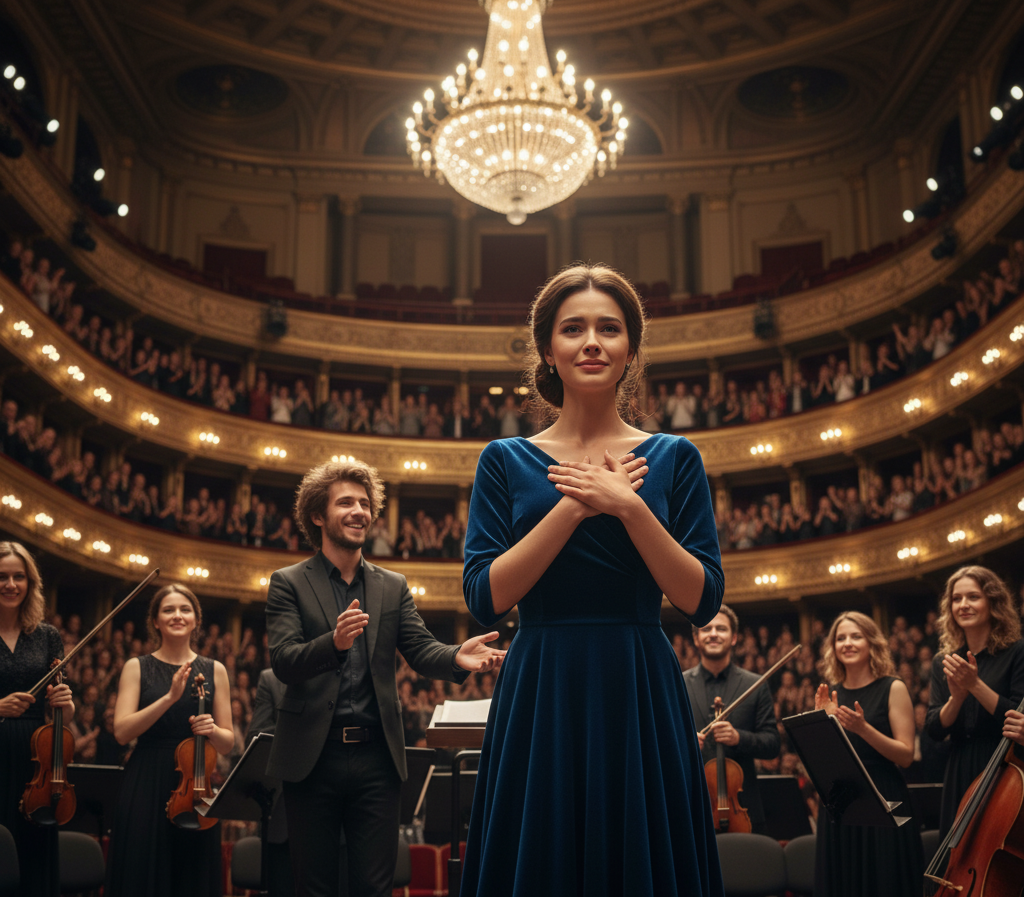
As the final notes of the symphony echoed through the hall, a thunderous applause erupted. The audience was on its feet, moved to tears. Leo, beaming, walked to the podium and gestured for Anya to join him. Her entire body froze. The old panic flared. But then, she saw his eyes, warm and encouraging, and the faces of the orchestra, filled with gratitude.
This wasn’t about her singing. This was about the music, and she had helped it find its voice. Slowly, she walked onto the stage, a wave of warmth washing over her as the applause intensified. She didn’t sing, she didn’t speak. She simply stood beside Leo, a silent force, a conductor of sound, receiving the praise for a melody that had truly found its heart.
Anya’s success wasn’t in overcoming her stage fright to become a solo vocalist. It was in realizing that her gift, her perfect pitch, was valuable even if she never uttered a note. It was in finding a way to contribute, to shape beauty, to live within the music she loved, without having to expose her deepest vulnerability. She discovered that success isn’t always about seizing the spotlight, but sometimes, it’s about helping the light shine brighter on something else. She learned that a muted heart can still conduct a symphony, that a silent presence can be the most profound voice of all. Her journey showed her that true success is finding the unique way your talents can serve the world, even if that way is an unseen melody, guiding others to their most perfect harmony.