
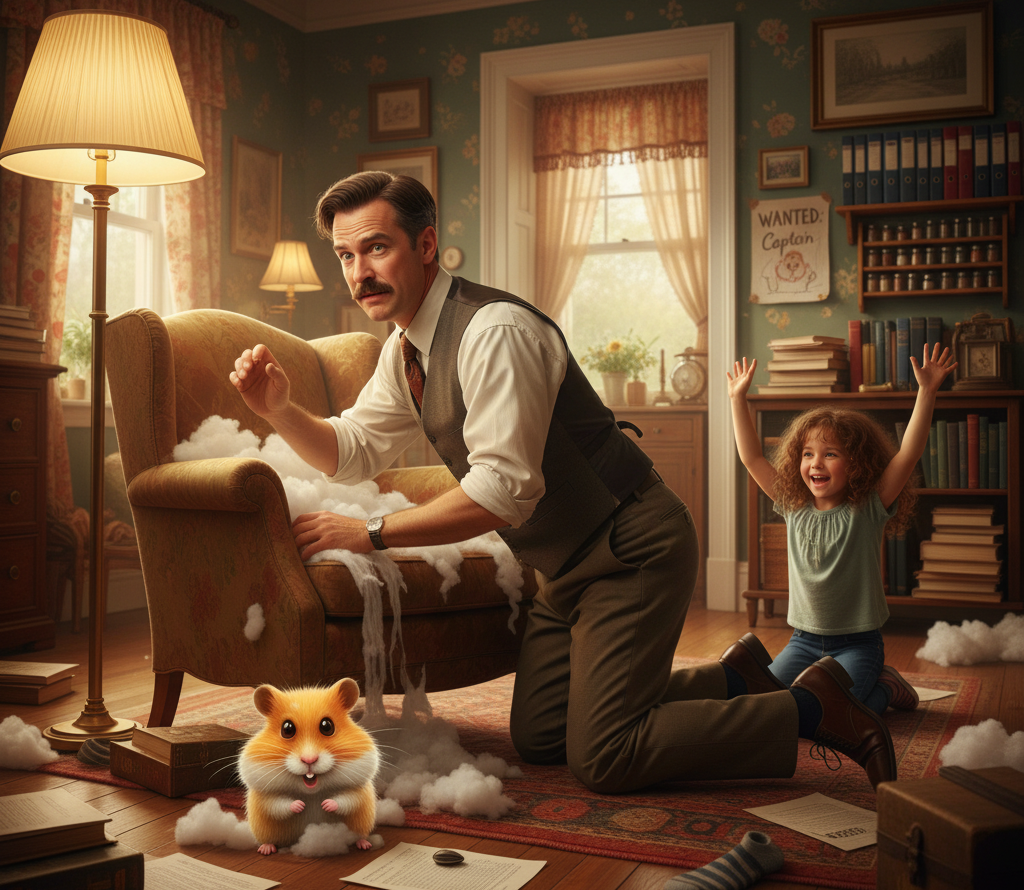
Barnaby Butterfield, a man whose life revolved around sensible socks and spreadsheets, found his meticulously ordered world utterly derailed by a creature no larger than a teacup: a hamster named Captain Fluffernutter.
Captain Fluffernutter belonged to Barnaby’s niece, eight-year-old Lily, who was visiting for the summer. The Captain, a furry orb of pure chaos, had somehow escaped his elaborate, multi-level cage, leaving behind a single, incriminating sunflower seed.
“Uncle Barnaby,” Lily announced with the solemnity of a tiny detective, “Captain Fluffernutter is missing. I believe he’s embarked on a perilous quest.”
Barnaby, who had been alphabetizing his spice rack, felt a cold dread creep up his sensible spine. A perilous quest usually involved a trip to the local pet store. “Lily, dear, I’m sure he’s just… misfiled himself.”
The search began. Barnaby, armed with a flashlight and a growing sense of panic, crawled through every dusty nook and cranny of his immaculate apartment. He discovered a lost mitten, three ancient paperclips, and a startling amount of lint, but no Captain. Lily, meanwhile, was meticulously placing “Wanted” posters (crayon drawings of a vaguely hamster-shaped blob) throughout the apartment, offering a reward of “one hug and infinite cuddles.”
Hours turned into an eternity. Barnaby, usually unflappable, was starting to unravel. He found himself questioning the very fabric of his existence. If a hamster could disappear so completely, what truly was stability? Was his perfectly organized life merely an illusion, a fragile façade that could be shattered by a tiny, furry escape artist? He began to eye his sensible socks with suspicion. Were they plotting something?
Just as Barnaby was contemplating the futility of human endeavor and the cosmic significance of a missing rodent, Lily shrieked. “Uncle Barnaby! He’s in the armchair!”
Barnaby rushed over. Indeed, from a tear in the antique velvet armchair (which Barnaby now remembered promising his mother he’d have repaired “sometime next year”), two beady black eyes stared back. Captain Fluffernutter, looking rather pleased with himself, had apparently decided the stuffing of the armchair made for superior, albeit illicit, real estate.
Relief washed over Barnaby, followed swiftly by exasperation. “Captain Fluffernutter,” he muttered, reaching in. “You little anarchist.”
But extracting the Captain proved more challenging than expected. The hamster, invigorated by his brush with freedom, had become surprisingly agile. He dodged Barnaby’s outstretched hand, leading him on a grand chase inside the armchair. Barnaby found himself wrestling with his own furniture, a grown man grunting and thrashing against an upholstered opponent, all while Lily cheered on the “heroic rescue mission.”
Finally, with a grunt of triumph and a minor upholstery injury, Barnaby managed to coax the Captain out. The hamster, looking utterly unrepentant, allowed himself to be scooped up by Lily, who immediately subjected him to “infinite cuddles.”
Barnaby, however, was a changed man. The incident had cracked open his perfectly ordered shell. Later that week, as he sat down to balance his accounts, he found himself humming a slightly off-key tune. He even left a single sunflower seed on his desk – a tribute, perhaps, to the spirit of spontaneous adventure, or maybe just a subtle warning to his sensible socks.
His world was still organized, mostly. But now, nestled somewhere between his perfectly aligned pencils and his color-coded binders, was a newfound appreciation for the delightful absurdity of life. And occasionally, when no one was looking, Barnaby would catch himself wondering: what other secret adventures were happening just out of sight, in the quiet corners of his seemingly predictable existence? He even bought a slightly less sensible pair of striped socks. Just in case.